
For Applying FCRA Registration Click Here…
What is FCRA Registration NGO?
FCRA registration NGO refers to the official approval granted by the Government of India that allows an NGO to legally receive foreign donations. Under the Foreign Contribution Regulation Act (FCRA), every NGO, trust, or society must obtain this registration before accepting any funds from outside India. The main purpose of FCRA registration NGO is to ensure that foreign money is used transparently and only for genuine social, educational, religious, or charitable activities.
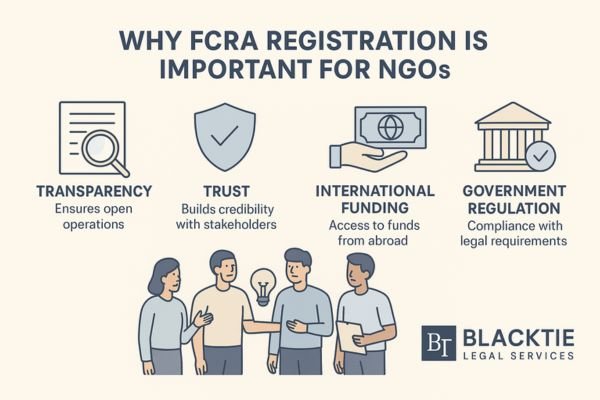
For NGOs working on large-scale community projects, FCRA registration plays a crucial role because it opens the door to international funding opportunities. Without FCRA approval, no NGO in India is legally permitted to accept foreign contributions. This registration also increases the credibility of the organisation, builds trust with donors, and shows that the NGO follows all government compliance rules. In simple terms, FCRA registration NGO acts as a legal gateway for NGOs to expand their impact using foreign support.

Eligibility Criteria for FCRA Registration NGO
To apply for FCRA registration NGO, an organisation must meet certain eligibility conditions set by the Government of India. These rules ensure that only genuine, responsible, and active NGOs receive permission to accept foreign contributions. The first major requirement is that the NGO must be registered as a Trust, Society, or Section 8 Company under Indian law. Unregistered or informal groups cannot apply for FCRA approval.
Another important eligibility criterion is that the NGO should be actively working for at least 3 years before applying for regular FCRA registration. During these 3 years, the NGO must have carried out genuine social activities and should have proper financial records to prove its work. The organisation must also show that it has spent a minimum amount (usually ₹15 lakh) on its charitable projects from its own funds. This amount may vary based on the latest government rules.
The NGO must not have any history of legal violations, fund misuse, or activities that go against national interest. For successful FCRA registration NGO, the organisation should maintain clean financial statements, audited accounts, and a transparent governance structure. Additionally, the NGO’s objectives must fall under permitted categories such as education, health, social welfare, culture, environment, religious activities, or humanitarian assistance.
Overall, these eligibility criteria ensure that only trustworthy NGOs receive FCRA registration and can responsibly manage foreign donations.
Documents Required for FCRA Registration NGO
To successfully apply for FCRA registration NGO, the organisation must submit several important documents that prove its legal existence, financial transparency, and credibility. These documents help the government verify that the NGO is genuine and capable of handling foreign contributions responsibly. Having all documents ready in advance makes the application process smoother and faster.
The essential documents required for FCRA registration NGO include:
1. Registration Certificate of the NGO
A copy of the Trust Deed, Society Registration Certificate, or Section 8 Company Incorporation Certificate is mandatory to prove the NGO’s legal status.
2. PAN Card of the NGO
A valid Permanent Account Number (PAN) establishes the organisation’s financial identity for compliance purposes.
3. Memorandum of Association (MOA) or Articles of Association (AOA)
These documents outline the NGO’s objectives and help the authorities confirm that the activities align with FCRA rules.
4. Audited Financial Statements (Last 3 Years)
The NGO must submit audited balance sheets, income-expenditure statements, and receipts-payments statements to show financial stability and transparency.
5. Activity Reports
Detailed annual activity reports for the last 3 years demonstrate that the NGO has been actively working on social or charitable projects.
6. Details of Key Members
Information such as names, contact details, Aadhaar/PAN numbers, and designation of governing body members is required to verify their background.
7. Bank Account Details (FCRA Account)
A dedicated FCRA bank account must be opened in a notified bank branch to receive foreign funds. This account detail is mandatory to add in the application.
8. Commitment Letters (Optional but Helpful)
If the NGO has any confirmed foreign donor commitments, attaching these letters strengthens the application.
9. Self-Declaration and Compliance Statements
Statements confirming that the NGO is not involved in prohibited activities and follows all legal norms are also required.
In short, collecting the right documents is one of the most crucial steps for FCRA registration NGO. Proper documentation increases the chances of approval and ensures a smooth registration process.
Step-by-Step Process for FCRA Registration NGO Online
Applying for FCRA registration NGO online is a simple and fully digital process through the official FCRA portal. The government has made the entire system transparent and user-friendly so NGOs can easily submit their applications without paperwork. Below is the step-by-step process to help you understand how FCRA registration is done online.
Step 1: Visit the Official FCRA Portal
Start by visiting the Ministry of Home Affairs (MHA) FCRA website. All applications for FCRA registration NGO must be submitted only through this portal.
Step 2: Create a User ID and Password
Register your NGO on the portal by creating a new login account. You will need basic details such as the organisation’s name, email ID, and contact information.
Step 3: Choose the Correct Application Form (Form FC-3A)
For fresh FCRA registration NGO, select Form FC-3A. NGOs applying for prior permission must choose Form FC-3B.
Step 4: Fill in the NGO’s Basic Details
Enter all required information, including registration details, PAN number, address, and objectives of the NGO. Make sure these details match your legal documents.
Step 5: Add Key Members and Governing Body Information
Provide the details of your NGO’s key office bearers such as President, Secretary, and Treasurer. Aadhaar/PAN details are required for verification.
Step 6: Upload All Required Documents
Upload scanned copies of documents such as:
- Registration certificate
- Audited financial statements
- Activity reports
- MOA/AOA
- Governing body details
- FCRA bank account details
Uploading correct documents improves the chances of approval.
Step 7: Enter FCRA Bank Account Details
For FCRA registration NGO, you must have a dedicated FCRA bank account opened in the State Bank of India (New Delhi Main Branch) or any other approved bank as per the latest rules.
Step 8: Review the Application Carefully
Before submitting, re-check all entered details and uploaded documents to avoid rejection due to errors.
Step 9: Pay the Application Fee Online
Make the payment using online methods like net banking or debit card. The fee is processed instantly.
Step 10: Submit the Application
After payment, submit the form. You will receive an acknowledgement with a reference number to track your FCRA registration status online.
Step 11: Application Verification by MHA
The Ministry of Home Affairs reviews the application, verifies documents, and may request clarification if needed. The process can take a few months.
Step 12: Final Approval
Once approved, the NGO receives its FCRA registration certificate, allowing it to legally receive foreign contributions.
The entire process is digital, making it easier for NGOs to apply without any physical documentation. Following these steps ensures a smooth and successful FCRA registration NGO online.
Types of FCRA Registration for NGOs (Normal vs Prior Permission)
When applying for FCRA registration NGO, organisations can choose between two types of approvals based on their eligibility and funding requirements. These two types are Normal FCRA Registration and Prior Permission. Understanding the difference between them helps NGOs select the right option and avoid delays in receiving foreign contributions.
1. Normal FCRA Registration
Normal FCRA registration is designed for NGOs that have been actively working for at least 3 years. To qualify, the NGO must show a proven track record of social work and submit audited financial statements for the last three years. This type of FCRA registration NGO provides long-term approval, usually valid for 5 years, allowing the organisation to receive unlimited foreign contributions from various donors.
Normal registration suits well-established NGOs that regularly work on large-scale projects, have stable governance, and meet all compliance requirements. Once approved, the NGO can accept foreign funds without needing prior approval for each donor.
2. Prior Permission Registration
Prior Permission is for NGOs that do not meet the 3-year requirement but have a specific foreign donor ready to fund a particular project. Under this option, the NGO must provide details of the exact donor, the purpose of the donation, and the amount expected. The donor must also issue a commitment letter to support the application.
Prior Permission is ideal for new NGOs or recently registered organisations that wish to receive foreign funding for the first time. However, it is limited to the specific donor and project mentioned during the application. If another donor wants to contribute later, the NGO must apply separately.
Which Type Should an NGO Choose?
- Choose Normal FCRA registration NGO if your organisation is well-established and meets the 3-year activity requirement.
- Choose Prior Permission if your NGO is new or has a confirmed foreign donor willing to fund a specific project.
Both options provide a legal path for NGOs to receive international funding, but the right choice depends on the organisation’s age, documentation readiness, and donor support.
Fees and Processing Time for FCRA Registration
Understanding the fees and processing time for FCRA registration NGO is important for any organisation planning to receive foreign funding. The Government of India has fixed the application fees and follows a structured timeline to review and approve each request.
FCRA Registration Fees
For applying online, NGOs need to pay a nominal fee, which may change slightly with new guidelines. Currently, the approximate fees are:
- ₹5,000 for Normal FCRA Registration (Form FC-3A)
- ₹3,000 for Prior Permission (Form FC-3B)
The payment can be made online through net banking, debit card, or other accepted modes on the official FCRA portal. These fees are non-refundable, even if the application is rejected, so accuracy in details is important.
Processing Time for FCRA Registration
The processing time for FCRA registration NGO depends on the type of application and the verification process. Generally:
- Normal FCRA Registration takes around 3 to 6 months.
- Prior Permission may take 2 to 4 months, depending on donor verification.
During this period, the Ministry of Home Affairs (MHA) reviews all documents, checks the NGO’s activities, and may request additional clarification if needed. Any mismatch in documents or incomplete details can delay the approval process.
Why Processing Time May Vary
Processing may take longer if:
- Documents are incomplete or unclear
- The NGO has compliance issues
- Additional verification is required
- Site inspection or background checks are needed
To avoid delays, NGOs must ensure correct information and proper documentation when applying for FCRA registration.
In summary, the costs are affordable, and the processing time is reasonable, making FCRA registration NGO accessible for both new and established organisations.
FCRA Registration Renewal Process for NGOs
The FCRA registration renewal process is extremely important for every NGO because FCRA approval is valid for only 5 years. If the NGO does not renew on time, its ability to receive foreign funds will be suspended. That’s why understanding the renewal steps is crucial for any organisation working with foreign donations. The renewal process ensures that the NGO continues to meet compliance standards and responsibly manages foreign contributions.
Step-by-Step FCRA Renewal Process
1. Log in to the FCRA Online Portal
The renewal of FCRA registration NGO is done completely online. NGOs must log in to the official FCRA portal using their existing user ID and password.
2. Select Form FC-3C (Renewal Form)
For renewal, NGOs must fill Form FC-3C. This form is specifically designed for organisations whose FCRA registration is expiring soon.
3. Update NGO Details
The NGO must review and update details such as:
- Registration information
- Governing body members
- Address and contact details
- Objectives and activities
Make sure all information is accurate and matches your official documents.
4. Upload Mandatory Documents
To complete the renewal for FCRA registration NGO, the following documents must be uploaded:
- Latest audited financial statements
- Activity reports
- Updated governing body list
- FCRA bank account details
- Self-declarations and compliance statements
Accurate documentation increases the chances of quick approval.
5. Pay the Renewal Fee
A renewal fee of around ₹5,000 must be paid online using net banking or a debit card. This payment is mandatory to process the renewal request.
6. Submit the Application
After completing all sections, review the form carefully and click submit. You will receive an acknowledgement number to track your FCRA renewal status online.
7. Government Verification
The Ministry of Home Affairs (MHA) verifies the NGO’s records, financial transparency, and compliance history. If everything is correct, the renewal is approved.
8. Receive Renewal Certificate
Once approved, the NGO receives a renewed FCRA certificate, allowing it to legally continue receiving foreign contributions for another 5 years.
Important Point
NGOs must apply for FCRA renewal at least 6 months before the expiry date to avoid any interruption in foreign funding.
Common Mistakes NGOs Make During FCRA Registration
Many organisations face delays or rejection because they repeat the same avoidable mistakes during the FCRA registration NGO process. Understanding these errors helps NGOs prepare better, submit accurate details, and improve their chances of getting approval on the first attempt.
1. Incomplete or Incorrect Documentation
One of the biggest mistakes is submitting documents that are outdated, mismatched, or missing pages. Even a small error—like a spelling mismatch in registration papers—can lead to rejection. All documents for FCRA registration NGO must be updated, clear, and legally valid.
2. Mismatch in NGO Details
NGO details such as name, address, registration date, or PAN number must match across all documents. If there is any inconsistency, the system flags it for clarification, slowing down the approval process.
3. Not Having an Eligible FCRA Bank Account
Many NGOs mistakenly try to apply without opening a designated FCRA bank account in an approved bank branch. Without this, the application cannot be processed and may be rejected.
4. Lack of Proper Financial Records
FCRA registration NGO requires 3 years of audited financial statements. Some NGOs fail to maintain proper accounts or submit unaudited statements, which immediately raises red flags for the authorities.
5. Weak Activity Reports
NGOs must submit detailed annual reports showing real work and achievements. Vague or incomplete activity reports make it difficult for the government to verify the organisation’s credibility.
6. Incorrect Selection of Form
Choosing the wrong application form—FC-3A instead of FC-3B or vice versa—is a common mistake. Each form is meant for a specific type of FCRA registration NGO, so selecting the correct one is crucial.
7. Ignoring Compliance Requirements
Some NGOs do not follow basic compliance rules like updating governing body details or filing annual returns. A non-compliant NGO is likely to face delays or rejection during the FCRA process.
8. Submitting the Form in a Hurry
Rushing through the application often results in data entry errors. A single typing mistake can cause the entire FCRA registration NGO application to be put on hold.
How to Check FCRA Registration Status Online
After applying for FCRA registration NGO, it is important to track the progress of your application. The Government of India provides an easy online system to check the status of your FCRA application anytime. Monitoring the status helps NGOs stay informed and respond quickly if the authorities request additional information.
Step 1: Visit the Official FCRA Portal
Go to the Ministry of Home Affairs (MHA) FCRA website: https://fcraonline.nic.in. Only the official portal should be used to check your FCRA registration NGO status.
Step 2: Click on “FCRA Services”
On the homepage, locate the “FCRA Services” section. This is where all application tracking features are available.
Step 3: Select “Track Application Status”
Choose the option “Track Application Status” to view the progress of your FCRA registration NGO application.
Step 4: Enter Application Details
You will need to enter:
- Application number or Reference number
- Year of submission
- Type of application (Normal Registration or Prior Permission)
Make sure the details match your submitted application.
Step 5: Submit and View Status
Click on “Submit” to see the current status of your FCRA registration NGO application. The portal will show whether your application is:
- Under process
- Pending clarification
- Approved
- Rejected
Step 6: Take Action if Required
If the status shows “Pending Clarification”, the NGO should provide the requested information immediately. Timely response ensures faster approval.
Step 7: Keep Reference Number Safe
Always save your application reference number for future tracking and correspondence with the authorities.
Checking the status online is simple, secure, and keeps NGOs updated throughout the FCRA registration NGO process. Regular monitoring prevents delays and helps maintain compliance.
Penalties for Non-Compliance Under FCRA
Compliance with FCRA regulations is mandatory for every NGO that holds FCRA registration NGO. Failure to follow the rules can lead to serious penalties, including fines, suspension, or even cancellation of the registration. Understanding these penalties helps NGOs maintain transparency and avoid legal troubles.
1. Suspension or Cancellation of FCRA Registration
If an NGO misuses foreign contributions, fails to submit annual returns, or violates any FCRA provisions, the government can suspend or cancel its FCRA registration NGO. This means the NGO will no longer be legally allowed to receive foreign donations.
2. Heavy Financial Penalties
The authorities can impose monetary fines on NGOs that fail to comply with reporting or accounting requirements. These fines are intended to discourage misuse of funds and ensure strict adherence to FCRA rules.
3. Legal Action Against Office Bearers
Key members of the NGO, including trustees, directors, or governing body members, can face criminal charges or prosecution under the FCRA Act if the organisation is involved in illegal activities or fund misappropriation.
4. Freezing of Bank Accounts
The FCRA bank account of non-compliant NGOs can be frozen, preventing the organisation from accessing or receiving any foreign contributions. This can severely disrupt ongoing projects and operations.
5. Reputational Damage
Non-compliance not only attracts legal penalties but also damages the NGO’s credibility among donors and partners. Once an NGO loses trust, it becomes difficult to secure funding from both domestic and international sources.
How to Avoid Penalties
- Always submit annual returns (Form FC-4) on time
- Maintain proper accounting and audited financial statements
- Use foreign funds only for approved activities
- Keep records of all donors and donations
- Ensure compliance with all FCRA rules
Benefits of Getting FCRA Registration for NGO
Obtaining FCRA registration NGO offers multiple advantages that help organisations grow, gain credibility, and access international funding. Beyond legal permission, FCRA registration opens doors to opportunities that can significantly enhance an NGO’s impact in society.
1. Legal Permission to Receive Foreign Donations
The most important benefit of FCRA registration NGO is that it allows an NGO to legally receive foreign contributions. Without this registration, accepting any international funds is prohibited, even for genuine charitable purposes.
2. Access to International Funding Opportunities
With FCRA registration, NGOs can approach global donors, foundations, and international agencies. Many foreign organisations and CSR programs fund only those NGOs that have valid FCRA approval.
3. Increased Credibility and Trust
Holding FCRA registration NGO demonstrates that the organisation follows government compliance rules and maintains transparency. This builds trust among donors, partners, and beneficiaries, making it easier to form collaborations.
4. Ability to Expand Programs
With access to foreign funds, NGOs can scale up their operations, start new projects, and reach more communities. This is especially beneficial for large-scale initiatives in health, education, women empowerment, or environmental protection.
5. Enhanced Transparency and Accountability
FCRA registration NGO requires proper accounting, audited financial statements, and annual returns. This ensures transparency, which not only satisfies legal requirements but also strengthens the NGO’s reputation among stakeholders.
6. Long-Term Growth and Sustainability
Foreign contributions can provide NGOs with steady and reliable funding for multiple years. This helps in planning long-term development projects and achieving sustainable social impact.
In short, FCRA registration NGO is a gateway to international support, credibility, and growth. It empowers NGOs to make a larger difference while staying fully compliant with the law.
FAQs on FCRA Registration NGO
What is FCRA registration NGO?
FCRA registration NGO is an official approval granted by the Government of India that allows an NGO to legally receive foreign contributions. It ensures that foreign funds are used for genuine social, educational, religious, or charitable purposes.
Who can apply for FCRA registration NGO?
Only NGOs registered as Trusts, Societies, or Section 8 Companies in India are eligible. The organisation must be actively working on social or charitable projects and comply with FCRA eligibility criteria.
How long does FCRA registration NGO take?
The processing time varies:
Normal Registration: 3–6 months
Prior Permission: 2–4 months
Delays may occur if documents are incomplete or clarification is required.
What documents are required for FCRA registration NGO?
Key documents include:
NGO registration certificate (Trust/Society/Section 8 Company)
PAN card of the NGO
MOA/AOA
Audited financial statements for the last 3 years
Activity reports
FCRA bank account details
Can a new NGO apply for FCRA registration?
Yes, but new NGOs that haven’t completed 3 years of activity must apply for Prior Permission, which is limited to specific donors and projects.
How can I check the status of my FCRA registration NGO application?
You can track the application online via the official FCRA portal using your application reference number and details submitted during registration.
How long is FCRA registration NGO valid?
FCRA registration is valid for 5 years. NGOs must apply for renewal at least 6 months before expiry to continue receiving foreign contributions.
What are the penalties for non-compliance with FCRA rules?
Penalties include suspension or cancellation of registration, fines, legal action against office bearers, freezing of FCRA bank accounts, and reputational damage.
Is it mandatory to open a separate FCRA bank account?
Yes. NGOs must have a dedicated FCRA bank account in a notified bank to receive foreign funds. Using regular bank accounts is not permitted under FCRA regulations.
What are the benefits of FCRA registration NGO?
Benefits include legal permission to receive foreign donations, access to international funding, increased credibility, ability to expand programs, and enhanced transparency.